
Isn’t it fascinating how our small heads manage to house a brain with such massive storage capacity? What’s even more amazing is how it retrieves the exact information we need, right when we need it, without getting its wires crossed. This tells us a simple truth: if we organize things following a smart roadmap, we can easily fit a massive world into a tiny space. The only catch is that the path to access everything must be kept completely clear.
Today, through graphics, practical examples, and a bit of storytelling, we’ve perfectly organized our own little kingdom. We’ve maximized the space so well that there’s even room left for the queen’s playroom or a tiny dance floor! By the way, if you want to keep getting regular tips on home, kitchen, and garden organization, don’t forget to hit that subscribe button.
What Actually Belongs in Your Small Pantry?
So, it’s safe to say that these items are pretty common in almost everyone’s small pantry. I’m guessing you have them too, or at least some close alternatives:
- Grains & Pulses
- Oils & Spices
- Snacks & Quick Meals
- Tea, Coffee & Beverages
- Sauces & Bottled Goods
- Baking Supplies
- Onions, Potatoes & Paper Towels
Beyond this, if you have a little extra space in your pantry, you can definitely add a few additional storage items like a slim rolling cart, under-shelf wire baskets, or a narrow slide-out rack.
However, you should never store things in your pantry that you might only use once or twice in a lifetime. Our storage space, time, and energy are incredibly valuable, and we simply can’t afford to waste them on just anything. The golden rule is: the more importance something holds in your daily life, the closer it should be kept to you.
Can an “Invisible Power” Really Double Your Small Pantry Space?
Yes, absolutely, we can do that! Think about it just as our face alone can represent the identity of our entire body, if we can apply that exact same logic here, our job is done.
What Doesn’t Belong in Your Small Pantry?
When space is limited, your pantry should only house your everyday essentials your true favorites. It shouldn’t be crowded with items that just sit there taking up precious room. Here are a few common unnecessary items you should clear out right away:
- Ingredients bought for just one recipe.
- Expired or stale spices and canned goods.
- Nearly empty boxes taking up full-size space.
- Appliances you use less than one a month .
Small pantry organize after cleaning
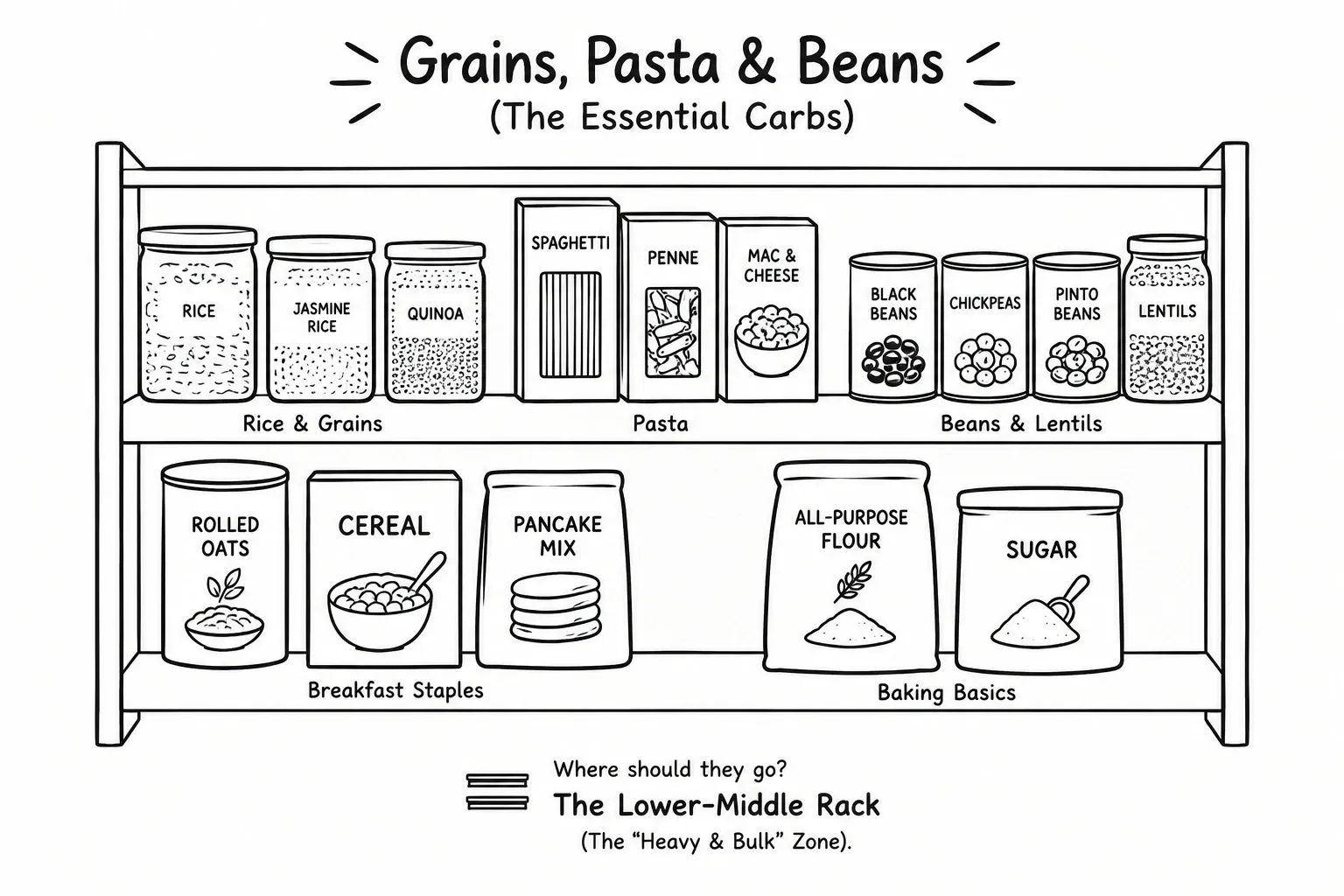
1. Grains, Pasta & Beans
If there’s one category that makes up the foundation of an American pantry, it’s this one. These are your everyday meal builders.
What belongs in this category?
- Rice & Grains
- Pasta
- Beans & Lentils
- Breakfast Staples
- Baking Basics
Where should they go?
The Lower-Middle Rack (The “Heavy & Bulk” Zone).
Flour, rice, and bulk grains get heavy very quickly, especially if you buy them in bulk from stores like Costco or Sam’s Club. Keeping these heavier acrylic containers or glass jars on the lower-middle shelves prevents dangerous spills and makes it much easier to pull them out when you need to scoop out a cup of flour or oats.
2. Oils, Vinegars & Spices
This category is the heartbeat of your kitchen. Whether you’re meal-prepping on a Sunday or whipping up a quick weeknight dinner, these are the items you reach for every single time you turn on the stove.
What belongs in this category?
- Cooking Oils
- Vinegars
- The “Holy Trinity” of Seasonings
- Everyday Spices & Blends
Where should they go?
The Eye-Level / Middle Rack (The “Everyday Essentials” Zone). Or, if you have one, the over-the-door rack!
Prime real estate is for things you use daily. When your skillet is hot and you need oil right away, you don’t want to be bending down to the floor or reaching on your tiptoes. Keeping these at eye level means you can grab exactly what you need in seconds without breaking your cooking flow.
3. Snacks & Quick Meals
This is undeniably the most visited section of any American pantry. Whether you need a quick 3 PM work-from-home pick-me-up, or the kids are hunting for an after-school treat, this category is all about high-speed convenience.
What belongs in this category?
- Salty & Savory Cravings
- Sweet & Energy Boosters
- Quick “In-a-Rush” Meals
Where should they go?
The Upper-Middle Rack. (Or, if you have kids, create a dedicated “Snack Station” on the Bottom/Floor Rack).
Snacks need to be highly visible and easily accessible. If you shove bags of chips to the back of a crowded shelf, they will get crushed and forgotten until they are stale. On the flip side, if you have younger kids, placing a dedicated wire basket on a lower shelf gives them the independence to grab their own approved after-school snacks without trying to climb your shelving unit.
4. Coffee, Tea & Beverages
Let’s be honest—for most of us, this is the most important section of the kitchen. When you stumble in at 6 AM before you’ve fully opened your eyes, you need this area to be perfectly organized and completely foolproof.
What belongs in this category?
- The Caffeine Fix
- The Tea Collection
- Powders & Mixers
- Hydration
Where should they go?
The Upper-Middle Rack (The “Breakfast & Morning” Zone).
Because you shouldn’t have to bend over or dig through a cluttered shelf before you’ve had your first cup of coffee! Keeping these items on the upper-middle rack puts them at the perfect height for a quick, grab-and-go morning routine.
5. Condiments, Sauces & Bottled Goods
Americans love their sauces. From Sunday game-day dips to summer backyard BBQ marinades, condiments can quickly take over your pantry if left unchecked. This section is all about taming the bottles and jars.
What belongs in this category?
- The Cookout Classics
- Asian & Spicy Staples
- Heavy Glass Jars
- Sweet Spreads
Where should they go?
The Middle Rack (The “Everyday Essentials” Zone) or an Over-the-Door Organizer.
Unopened bottles and jars come in completely awkward shapes and sizes. Keeping them in the middle zone ensures you can easily read the labels without crouching down or getting a step stool. If you have an over-the-door wire rack, smaller bottles fit perfectly there, freeing up valuable deep-shelf space for bigger items.
6. Baking Supplies & Sweet Treats
Unless you are running a home bakery or binge-watching The Great British Baking Show, chances are you aren’t pulling out the flour and sugar every single day. This category is for all those essential ingredients that come to life during the holidays, weekend projects, or sudden late-night brownie cravings.
What belongs in this category?
- The Dry Basics
- Sugars & Sweeteners
- The Fun Stuff
- Boxed Mixes
Where should they go?
The Top Rack (The “Rarely Used” Zone).
For most households, baking ingredients are accessed weekly or monthly, rather than daily. Keeping them on the highest shelf frees up the “prime real estate” at eye-level for the items you reach for every single day. Plus, keeping the chocolate chips and marshmallows up high helps keep them out of reach of sneaky little hands!